◈Results
Results you can trace back to the work.
We connect the condition, the supporting evidence, the next move, the action and the confirmed outcome — so improvement can be inspected instead of assumed.
- Condition — Observed
- Evidence — Observed
- Attention — Derived
- Next move — Proposed
- Action — Approved or permitted
- Outcome — Verified — or still unknown
Six links, and only the last one is a result.
Most reporting collapses these into one word. Select a link to see what kind of claim it actually is.
A booking exists with nothing confirming the appointment was agreed.
ObservedThis is recorded fact. It came from the systems, not from an inference.
What we mean by a result.
These are outcomes the system is designed to support, each shown with the working behind it. What any one business sees depends on the systems it already runs.
- Operational visibilitySee which opportunities still require attention, in one place, instead of reconstructing it across tabs.
- Response and follow-up disciplineKnow which commitments are unconfirmed while there is still time to act on them.
- Financial and attribution claritySeparate collected revenue from open receivables, and connect booked work to its demand source where the evidence supports it.
- Data trust and accountabilityKnow when a source is stale instead of trusting an incorrect zero, and see which action ran under which permission.
Six kinds of claim, kept apart.
This distinction is the point of the page. Collapsing these is how reporting starts to mislead — usually without anyone intending it.
- Observed activityIt happened and a system recorded it.
- Derived signalWe inferred it from records. It is checkable, and it is not fact.
- Recommended actionProposed, with its reason attached. Not performed.
- Executed actionIt ran. What ran and under which permission is recorded.
- Confirmed outcomeThe result is verified against evidence.
- Unknown resultNot yet confirmable — and reported as unknown rather than assumed.
Synthetic demo workspace
What the demo actually proves.
We keep a fully synthetic workspace so the behaviour of the product can be demonstrated without exposing anyone's operation. It proves how the system handles evidence — not how a business performed.
Its revenue and activity are generated. They are not a customer result, and nothing TaskGeniusAI did produced them.
- Records reconcile across lifecycle stages
- Numbers open onto the evidence behind them
- Source freshness is visible on the number
- Missing information stays unavailable, never a confident zero
- Attention items trace back to specific records
- Recommendations show their reason and control state
Synthetic demo workspace
What it looks like when a number refuses to overstate itself.
Three separate figures here decline to report a comparison, and each one says why. That is the standard, shown rather than described.
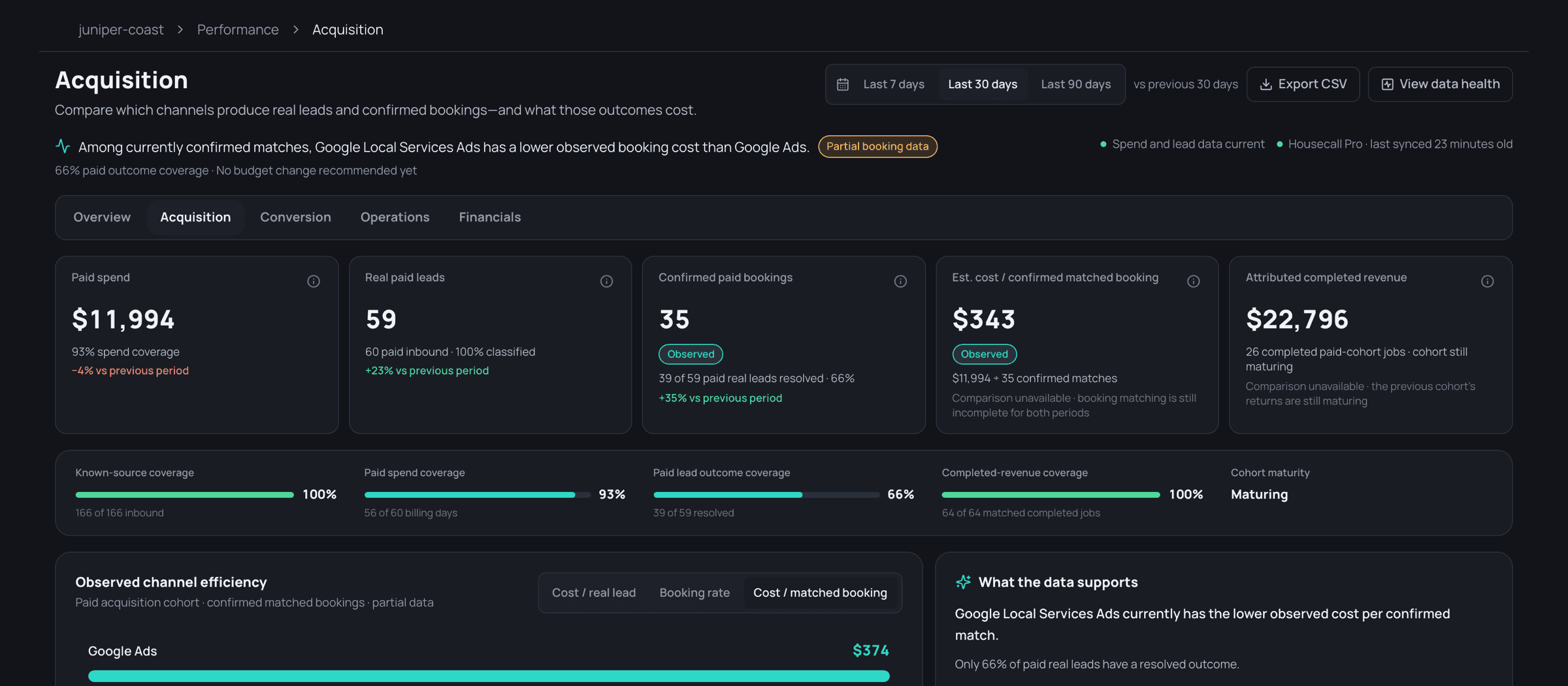
We have not published customer case studies yet.
A case study needs written permission, an agreed baseline, a stated timeframe, an honest note about what attribution can and cannot show, and wording the customer has approved. Until a study clears all of that, publishing nothing is the more accurate answer — and it is the same standard we would hold your numbers to.
Define the result before building the workflow.
We will identify the evidence, the baseline, the operating change and the verification method before calling anything a result.